


Is there a staff hire that you’ve been thinking about for months? Maybe longer. You’re not alone. Many owners of property service and trade businesses face the same dilemma.
You know you need another pair of hands. The work is there. The enquiries are coming through. You are stretched thin, and you know it. But every time you sit down to actually make the decision, something stops you.
It is not that you can’t afford it. It is that you are not sure you can guarantee the work will be there consistently enough to justify the ongoing commitment. And so the decision gets deferred. Again.

This is one of the most common positions I see growing trade businesses stuck in. And the reason it is such a frustrating place to be is that the problem is not just finding the right staff. The problem is: how do I make sure the business can sustain them and many others long term?.
Why the hiring decision feels so much riskier than it should
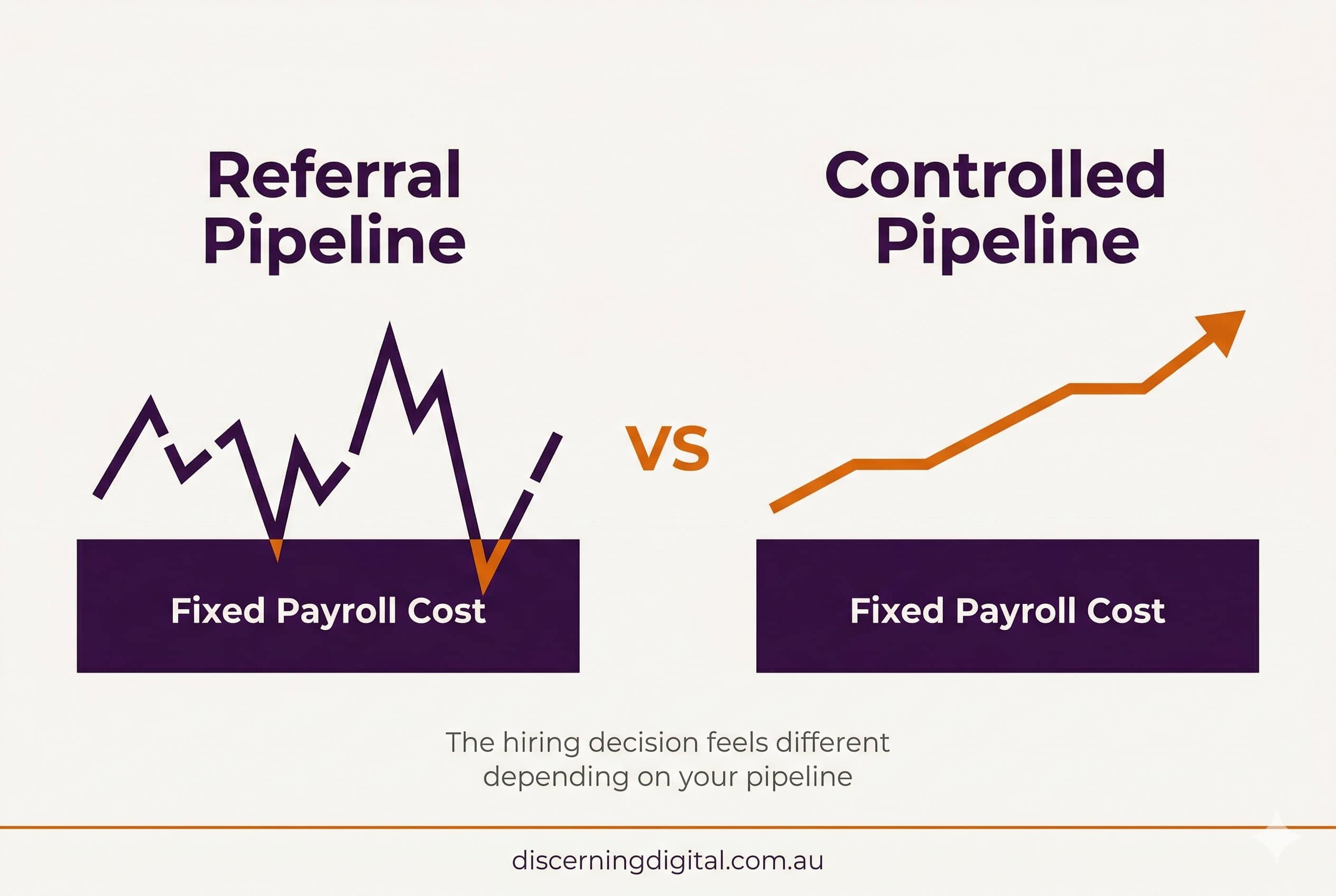
When a trade or service business is running primarily on referrals and word of mouth, the revenue feels reliable right up until it doesn’t. Month to month, things look fine. But there is no real visibility over where the next six weeks of work is coming from, let alone the next six months.
In that environment, taking on a new employee is a significant bet. You are committing to a fixed cost every fortnight, regardless of what happens with the work. If the pipeline stays consistent, great. If it takes a dip for a reason you couldn’t predict, that commitment does not pause with it.
So most business owners in this position do the sensible thing. They wait. They tell themselves they will hire when they are more confident. And in the meantime, they stay stretched, they turn down jobs they could take on, and the business does not grow the way it could.
The question worth asking is: confident about what, exactly? And how would you get there?
The referral dependency problem with growing teams
Here is the part of this that does not get talked about enough.
A referral-based pipeline that comfortably sustains a solo operator or a small two to three person business may not sustain a growing team. The fixed cost goes up with every hire. The pipeline does not automatically scale with it.
Which means that if the enquiry source is still primarily referrals and repeat work when you bring on that first extra person, you have just increased your exposure without addressing the underlying issue. The same pipeline that’s been held up by your relationships, referrals and your physical efforts, now has more dependent on it.
Sorting out your controllable lead channel is not something that should come after the hire. It is the thing that makes the hire safe.
The difference between hiring from hope and hiring from data
But what if this decision could feel completely different? Not because you’ve managed to have more guts to take on a bigger risk, but because you’ve got more information to base your decision on.
When a business has diversified and controllable lead flow, the hiring decision changes shape entirely. You are not just depending on relationships and effort for business to come through. You experience a consistent volume of qualified enquiries coming through each week, at a cost per lead you can plan for, and a pipeline you can control moving forward.

That then becomes a completely different conversation. You are not hoping the work will be there. You have confidence it will be there when you need it.
What a controllable lead channel actually changes about the hiring decision
When enquiries are consistent and trackable, a few things happen that make the decision to hire a lot less stressful.
First, you can model it. You know your average job value. You know your current enquiry volume. You know your conversion rate. Working out those sums tells you what the revenue ceiling looks like with the current team, and what it could look like with one more person on board.
Second, you have a track record to work from. Not two good months followed by a slow month. A booking schedule you can now control to suit whatever is happening in the business.
Third, the new hire changes from a stressful and costly risk to a clear decision. If the bookings are there and you do not have the capacity to handle it, you are actively leaving revenue on the table. That reframes the question. It is no longer whether you can afford to hire. It is whether you can afford not to.
A Perth local service business got there. The owner had been trying to manage their own digital marketing for months. Genuine investing their time and effort above everything else they had to do. But without the right foundations in place, the results were not coming through and the time spent on it was time not spent running the business.

When the marketing was finally set up properly, new enquiries started arriving from the first month. The business broke its own record three times in under six months. December, usually the hardest month of the year in their industry, came in as their best December on record. By that point the question was not whether to hire. It was how quickly they could bring someone on to keep up with the demand as they knew they were now in control.
What to look for before you commit to the next person
If you are at the point where you know you need to grow the team but you are not yet confident in the pipeline, the most useful thing you can do is fix the pipeline before making the hiring decision. Here is what that looks like in practice.
The most controllable lead channel available to a local property services and trade business is Google Ads. When someone in your area searches for the exact service you offer, a well-structured campaign puts you in front of them at that moment. The search is occurring whether you show up and get chosen or not.
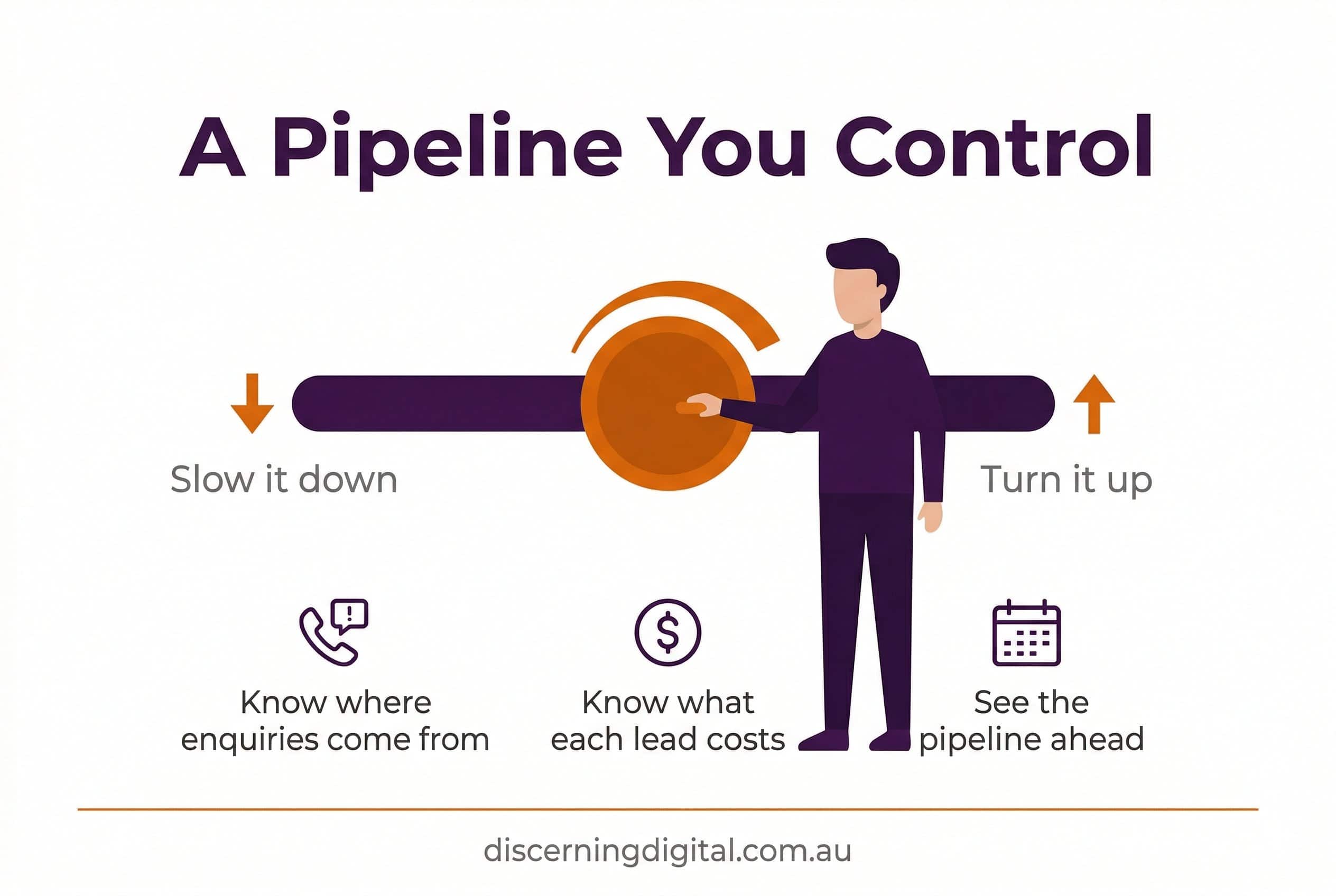
What makes this different to referrals is control. You decide how much lead flow you want. Need to fill a quiet patch? You turn it up. Fully booked for six months and want to slow the enquiries while you catch up? You pull it back. That kind of control over your own pipeline is something a referral-dependent business simply does not have.
And when the tracking is right, every enquiry that comes through is visible. You know where it came from, what it cost, and what the pipeline looks like going forward. That is what makes the hiring decision feel different. Not a leap of faith based on how the last few months felt. A clear business decision based on numbers you can actually see.
How to Grow a Trade Business on Your Terms
The property services and trade businesses that grow confidently are not the ones taking bigger risks. They are the ones that have built a pipeline they can control.
The hire you keep talking yourself out of does not have to stay that way. But the thing that changes the decision is not courage. It is data.
If you are running a property services or trade business in Australia and you are at the point where you need to grow but you are not sure the pipeline is solid enough to support it, that is exactly the conversation worth having.
Because figuring out how to grow a trade business sustainably starts with knowing where the next job is coming from.